Miami Metromover Guide: Downtown's Free People-Mover (First-Timer's Playbook)
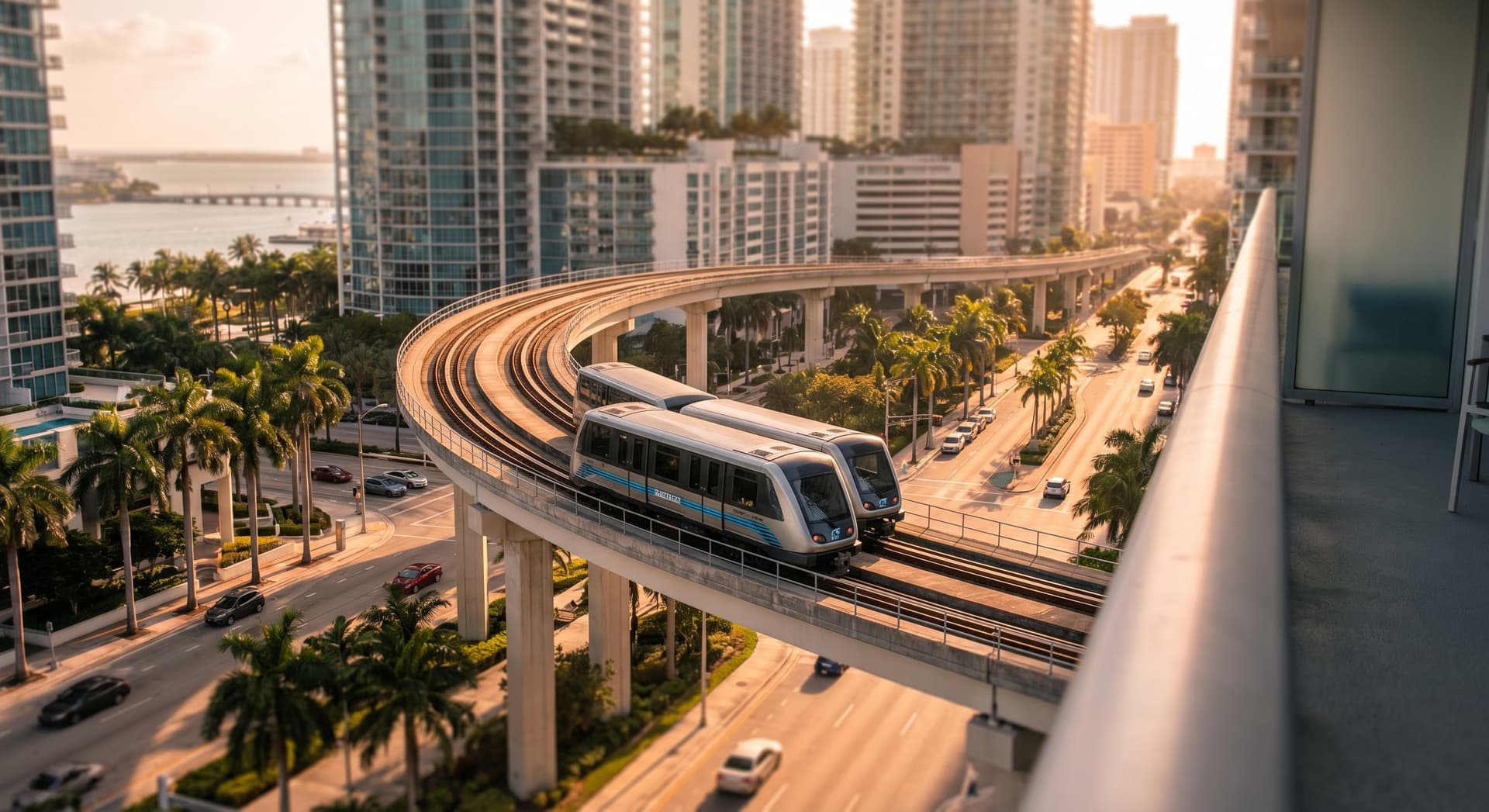 AI-generated (Nano Banana Pro)
Nobody warns first-time visitors about the Miami Metromover — and that's a shame, because it's one of the best-kept secrets in American urban transit. It's elevated, automated, air-conditioned, runs every 90 seconds, and costs absolutely nothing to ride. For anyone staying in Downtown Miami or Brickell, it can turn a hot, confusing walk into a breezy two-minute glide over rooftops.
Here's everything you need to know to use the Metromover like a local on day one.
Quick Facts
| Detail | Info |
|---|---|
| Cost | Free, no ticket required |
| Hours | Daily, 5:30 AM – 10:00 PM (extended for major events) |
| Frequency | Every 90 seconds peak, every 3 minutes off-peak |
| System length | 4.4 miles (7.1 km), fully elevated |
| Stations | 21 stations across 3 loops |
| Operator | Miami-Dade Transit |
| Accessibility | Fully ADA-compliant — elevators and ramps at every station |
| Phone / info | 3-1-1 in Miami, or the GO Miami-Dade app |
What the Metromover Actually Is
The Metromover is a driverless, rubber-tired automated people-mover that runs on an elevated concrete guideway one or two stories above the street. It opened in 1986 as a short Downtown loop and was expanded in the 1990s to include Brickell and the Omni/Arts District. Today it's a 21-station network that covers almost every corner of central Miami worth visiting on foot — from Bayfront Park and Bayside Marketplace in the east to the Perez Art Museum and the Adrienne Arsht Center on the north end.
It's not a Metrorail (the heavy-rail system that runs out to the suburbs and the airport). And it's not a streetcar or a tram. It's a small, frequent, short-hop loop designed to move people around a very compact area very quickly. Think of it as a free horizontal elevator that happens to serve 21 different doors.
The Three Loops
The system is laid out as three overlapping loops that share the same cars and platforms. You don't need to "catch the right line" the way you would on a New York subway — just look at the front of the train for the destination name, and hop on anything going in your direction.
- Downtown Loop — The core figure-eight through central downtown. Hits Bayfront Park, Government Center, Wilkie D. Ferguson Jr., Miami Avenue, Knight Center, and the College stations.
- Brickell Loop — Heads south across the Miami River into Brickell. Stations include Financial District, Fifth Street, Eighth Street (Brickell City Centre), Tenth Street/Promenade, and Brickell Station (where you transfer to Metrorail).
- Omni Loop — Heads north into the Arts & Entertainment District. Stations include Freedom Tower, Park West, Eleventh Street, School Board, and the Adrienne Arsht Center.
To cross between the Brickell and Omni sides, you generally switch trains at Government Center or Third Street — but honestly, the system is small enough that you can just stay on any train for a full circle and you'll get where you're going in under 25 minutes.
Stations Worth Knowing by Name
A handful of stations unlock almost everything a tourist would want to see downtown:
- Bayfront Park Station — Drops you between Bayfront Park and Bayside Marketplace. Closest stop to the InterContinental and the Port of Miami cruise terminals (a short rideshare away).
- Museum Park Station — The front door for Perez Art Museum Miami and the Frost Science Museum.
- Government Center Station — The big transfer hub. Metrorail connects here, along with most major downtown bus lines. HistoryMiami and the Main Library are upstairs.
- Adrienne Arsht Center Station — Performing-arts campus, plus it's a short walk to the Design District on an Uber rather than a long walk.
- Brickell Station / Eighth Street Station — The Brickell heart. Brickell City Centre shopping, Mary Brickell Village restaurants, and the second Metrorail transfer point.
- Third Street Station — Handy for the historic core and walks toward the riverfront.
How It Connects to the Rest of Miami
The Metromover is the downtown spine, but it only makes sense in combination with its siblings. Metrorail, Miami's heavy-rail line, runs from Dadeland in the south all the way to the airport and up to Palmetto. You transfer between the two systems for free at Government Center and Brickell Station. Metrorail costs $2.25 per ride; Metromover stays free regardless.
If you're flying in and wondering whether you can ride the Metromover from MIA, the answer is no — but you can string it together. From the airport, the free MIA Mover takes you to the Miami Intermodal Center, where you board the Metrorail Orange Line into Downtown or Brickell, then step across the platform onto the Metromover. For a full breakdown of car-free logistics, see our guide to getting around Miami without a car and the Miami airport layover playbook.
The Smartest Tourist Itinerary
Here's the Metromover loop I run most with out-of-town friends — a half-day that hits the best of downtown without breaking $20:
- Start at Brickell Station for a coffee at one of the cafés inside Brickell City Centre.
- Hop on and ride to Museum Park for an hour at PAMM and the bayfront sculpture terrace.
- One stop to Bayfront Park for a Biscayne Bay walk and lunch at Bayside Marketplace.
- Ride north to Adrienne Arsht Center — snap the curved Pelli architecture, then rideshare six minutes to Wynwood or the Design District for the afternoon.
- Loop back and get off at Government Center if you want to see the Miami-Dade Cultural Plaza before heading home.
Total Metromover fare for the day: $0.
Safety, Etiquette & Common Mistakes
The Metromover is generally safe and well-trafficked during daylight hours and early evening, especially around Brickell City Centre, Bayfront Park, and Museum Park. A few practical notes:
- Stay behind the yellow line on the platform — trains pull in fast.
- The last Metromover of the night leaves around 10:00 PM. Don't plan late-night returns around it; use a rideshare after 9:45 PM to be safe.
- Stations late at night can feel empty. If you're alone after dark, we'd stick to Brickell Station, Eighth Street, or Bayfront Park, where there's steady foot traffic. For broader context, see Miami safety for first-time visitors.
- No food, drinks, or smoking on the trains.
- Trains are tiny and can lurch — hold on to a pole, and lock stroller wheels.
- Don't assume Metromover replaces walking. Stations are only 2–3 blocks apart, and between hops you'll still do real walking in Miami heat. Bring water.
A system-wide modernization project (funded by the county half-penny sales tax and the FTA) is rolling through stations into late 2026, which is why hours were trimmed to 10:00 PM in mid-2025. Expect occasional single-station closures — Miami-Dade Transit posts them on the GO Miami-Dade app. The upside when upgrades finish: even more frequent trains and a platform ready for future expansion.
For a driver's-eye alternative perspective, see our parking in Miami guide — because once you ride the Metromover a few times, you'll probably start leaving the rental car at the hotel anyway.